Author Archive
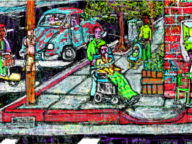
The First Curb Cuts
Archive Entry Date: 1990s
A disability rights artist and activist illustrates the era's lively momentum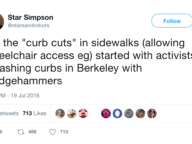
DIY Curb Cuts in Twittersphere
Archive Entry Date: July 2016
A tweet brings the disability narrative of sledgehammer wielding activists into 21st century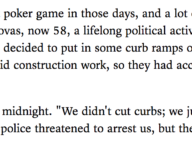
Midnight Contractors
Archive Entry Date: 1972
The impetus to build their own curb cuts sparked during a weekly poker game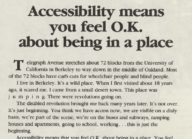
Accessibility Means You Feel O.K. About Being in a Place
Archive Entry Date: 1986
To legendary disabled playwright Neil Marcus, ramping was only the beginning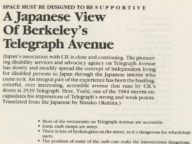
A Japanese View of Telegraph Ave
Archive Entry Date: 1986
A Japanese CIL intern compared the US and Japanese experience of disability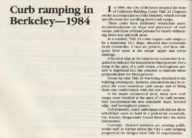
Curb Ramping in Berkeley—1984
Archive Entry Date: 1986
What worked with the first curb cuts wasn't going to work now...
Photograph of Hale Zukas
Archive Entry Date: 1982
Hale, a Berkeley icon, goes to work in Washington's federal Access Board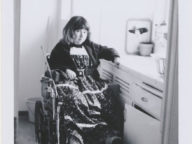
Portrait of Mary Ann Hiserman
Archive Entry Date: 1980
In her private space, Mary Ann exercises autonomy as a form of liberation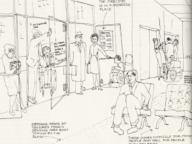
Getting There: A Guide to Accessibility for Your Facility
Archive Entry Date: 1979
A quirky accessibility guide demonstrates human-centered design with panache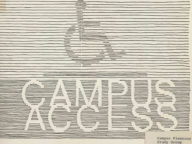
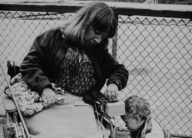
Photograph of Mary Ann Hiserman
Archive Entry Date: c. 1979
Mary Anne arrived to Berkeley with a dream, in the end she soared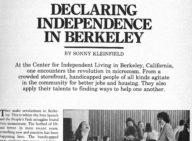
Declaring Independence in Berkeley
Archive Entry Date: August 1979
A synthetic account of Berkeley's disability rights revolution, with the CIL at its center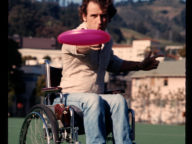
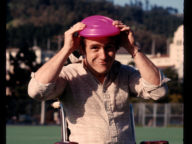
Frisbee Play Pt. I
Archive Entry Date: c. 1979
An unidentified student caught in a playful moment on Berkeley's green
An Advanced Studio Summer Session
Archive Entry Date: Summer 1979
In Lifchez's ARCH101, students designed accessible structures in real world settings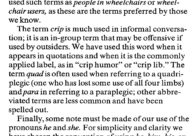
A Word on Words
Archive Entry Date: 1979
In its use of the term "crip," the landmark book Design for Independent Living captures the ethos of a revolution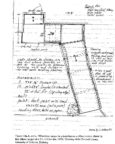
Wheelchair Ramp Plan for a Private Residence
Archive Entry Date: ca. 1978
To make private housing more accessible, Eric Dibner drew up ramp plans for the greater community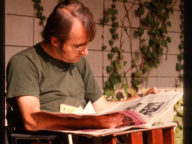
Man Perusing Newspaper
Archive Entry Date: c. 1978
A man reads a local Berkeley newspaper on a sun-filled morning
Adapting to Disability with Style
Archive Entry Date: 1978
Embossed leather details turn an adaptive device into a fashion statement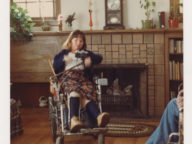
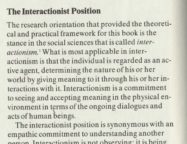
The Interactionist Position
Archive Entry Date: 1979
A clipping from a seminal text illustrates shift towards architecture as a social art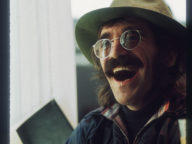
Michael Williams
Archive Entry Date: 1978
A local Berkeley disability rights activist captured in moment of glee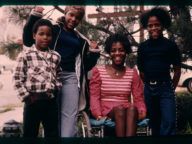
Group Portrait
Archive Entry Date: March 1978
A family radiates positive energy while posing for a snapshot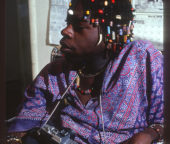
Man with Camera
Archive Entry Date: March 1978
A collection of photos depicting behind-the-scenes looks at the everyday lives of people with disabilities thriving in Berkeley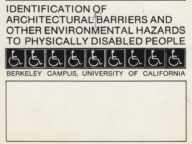
Campus Grounds Accessibility Audit
Archive Entry Date: September 1976
The 1000-page report was the first campus environmental survey of its kind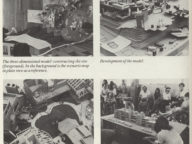
Scenario Mapping
Archive Entry Date: 1976
A colorful two-dimensional collage was a crucial step towards understanding a client's needs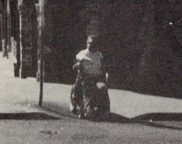
Phil Draper at Corner of Telegraph Ave and Blake St
Archive Entry Date: c. 1976
A co-founder and director of CIL cruises America's most accessible street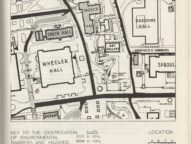
Map from Identification of Architectural Barriers
Archive Entry Date: September 1976
An environmental audit revealed that virtually all common routes on Berkeley's campus were inaccessible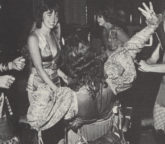
Wheelchair Dancing
Archive Entry Date: c. 1970s
An image, courtesy of Jane Scherr, of the thrill of ecstatic wheelchair movement